Specimen QD-2939 · recorded live 2026-10-25 12:58 UTC · Zetaris TPCDS_DBOpen Agent Hackathon 2026 · Reasoning Architecture
Findings · verified by execution
Same rows. Faster. Or the doctor won't sign.
Dropping an unused LEFT JOIN made our hero query 2.11× faster on Zetaris across 10 paired runs — unless the joined key has duplicates; then the same edit quietly changes the count. Query Doctor executes both versions on the engine before anyone merges and signs only when the rows match. Rewrites shipped with changed rows: 0.
runs keyless in sample modeexecutes both queriesa model never decides
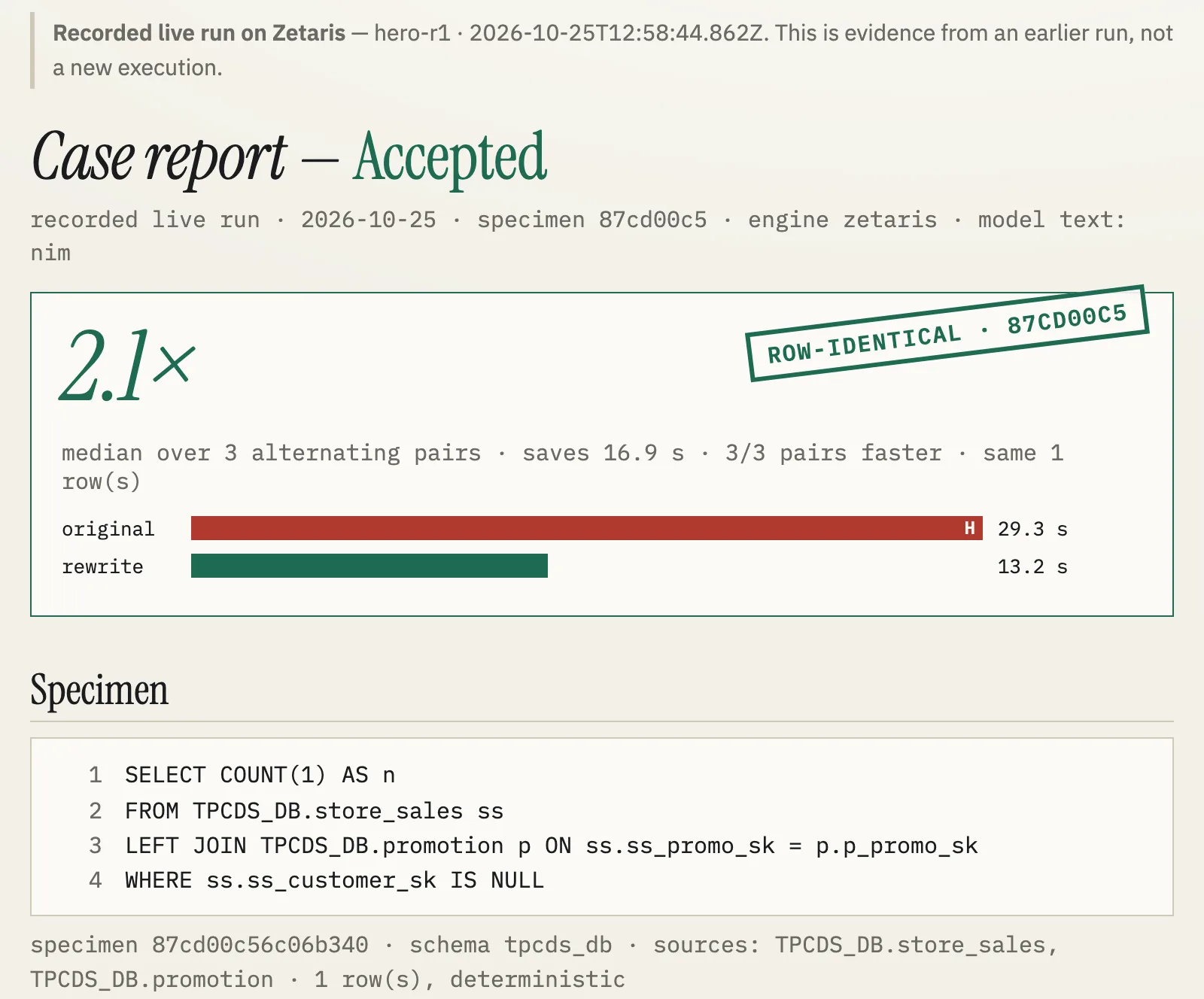
Case report hero-r1
recorded live · Zetaris
Specimen · the rewrite drops the struck line
SELECT COUNT(1) AS n
FROM   TPCDS_DB.store_sales ss
LEFT JOIN TPCDS_DB.promotion p ON ss.ss_promo_sk = p.p_promo_sk
WHERE  ss.ss_customer_sk IS NULL
The key is unique, so the join cannot change the count.
Results vs reference · per-side medians of 3 alternating pairs
2.1×live verdict · median pair ratio · 3/3 pairs faster · saves 16.9 s (median pair saving)
original
H
29.3 srewrite13.2 s
original87cd00c5rewrite87cd00c5
ROW-IDENTICAL · 87CD00C5
Verified by Verifier — code, no model · recorded live on Zetaris
recorded/live/hero-r1/case.json
2.11×
hero speedup on Zetaris, bench
median of 10 per-pair ratios, 10/10 faster, same row (p50 ÷ p50 = 1.97×); the live verdict was 2.1× over 3 pairs · DEMO.md (bench), recorded/live/hero-r1 (live verdict)
0
rewrites shipped with changed rows
an ACCEPT needs an identical row fingerprint · evals/results.md
6 / 15
baseline rewrites that changed rows
one plain model call, same Verifier, DuckDB sample pack · evals/results.md
447
tests, no keys needed
34 files · npm test
Report · hero-r1, shown twice
The report a reviewer signs, and the trace behind it.
Left, the app's Report screen replaying the recorded live run. Right, the same run's agent trace, line by line: the Verifier runs the original twice, the Diagnoser reads the plan and the key, the Rewriter proposes, the Verifier times three alternating pairs and signs.
scroll the screen sideways →
localhost:8000/#/recorded/hero-r1
Real screen · npm start → #/recorded/hero-r1 · evidence from the recorded run, not a new execution
logs/live-hero-r1.jsonl · 21 events · 12:58:44 → 13:03:09 UTC re-set from the recorded JSONL · real timestamps · plays about 50× faster
12:58:44Orchestratorstart_caseengine zetaris; llm nim; attempt cap 3
12:59:09Verifierexecute1 row(s) in 24460.9 mszetaris:run_sql
12:59:46Verifierexecute1 row(s) in 37452.7 mszetaris:run_sql
13:00:41RewriterrewriteRemoved unnecessary LEFT JOIN to promotion since no promotion columns are referenced and p_promo_sk is unique, so the join cannot change the | sql SELECT COUNT(1) AS n FROM TPCDS_DB.store_sales ss WHERE ss.ss_customer_sk IS NULLnim:chat_completions
13:00:59Verifierexecute1 row(s) in 18157.7 mszetaris:run_sql
13:01:27Verifierexecute1 row(s) in 27703.2 mszetaris:run_sql
13:01:40Verifierexecute1 row(s) in 13228.6 mszetaris:run_sql
13:01:56Verifierexecute1 row(s) in 15470.7 mszetaris:run_sql
13:02:28Verifierexecute1 row(s) in 32414.6 mszetaris:run_sql
13:02:58Verifierexecute1 row(s) in 29309.4 mszetaris:run_sql
13:03:09Verifierexecute1 row(s) in 11562.9 mszetaris:run_sql
13:03:09VerifiercritiqueACCEPT: same 1 row(s), 2.1× median over 3 pairs
13:03:09Orchestratorcase_verdictACCEPTED
Method · three agents and an orchestrator, one rule
A model proposes. Code decides.
Nemotron writes the diagnosis and the rewrite. The verdict, every number and every timing come from code that executes both queries on Zetaris.
code · no model
Verifier
It runs the original and the rewrite on the engine and refuses anything it cannot measure.
determinism pre-check — the original runs twicesame rows
schema check — column names and typesequal
row diff, or an engine-side row hash above the cap0 rows differ
alternating paired timing — ≥ 1.2×, most pairs wonsaving ≥ 1,782.9 ms (Zetaris noise floor)
xxhash64 · EXPLAIN FORMATTED · run_sql
hero-r1 · the three timed pairs in the order they ran — the order swaps each pair
pair 1
original 27.7 s
rewrite 13.2 s
pair 2
rewrite 15.5 s
original 32.4 s
pair 3
original 29.3 s
rewrite 11.6 s
per-side medians 29.3 s → 13.2 s · 2.1× = median of the three pair ratios · saves 16.9 s = median pair saving · recorded/live/hero-r1
model
Diagnoser
Reads the Spark plan, a pattern detector and SQL-aggregate key facts.
hero: unused_outer_join at plan node 7 · key 300 distinct of 300
nemotron-3-ultra-550b-a55b
model
Rewriter
One rewrite per hypothesis. It sees every earlier refusal as a reason code, and the latest one with the Verifier's detail and the differing row.
nemotron-3-ultra-550b-a55b
code
Playbook
Refusals, and outcomes a human approves, go into the playbook. A candidate already refused for the same original result is answered from the ledger, not run again.
Meterless H-MEM
code
Orchestrator
Runs the retry chain: one attempt is one chunk. "Correct but no time saved" (no_gain) goes back to Diagnoser.revise; at most three attempts.
Meterless Markovian
Comments · the same edit on two keys
Three wrong rewrites, kept on the page.
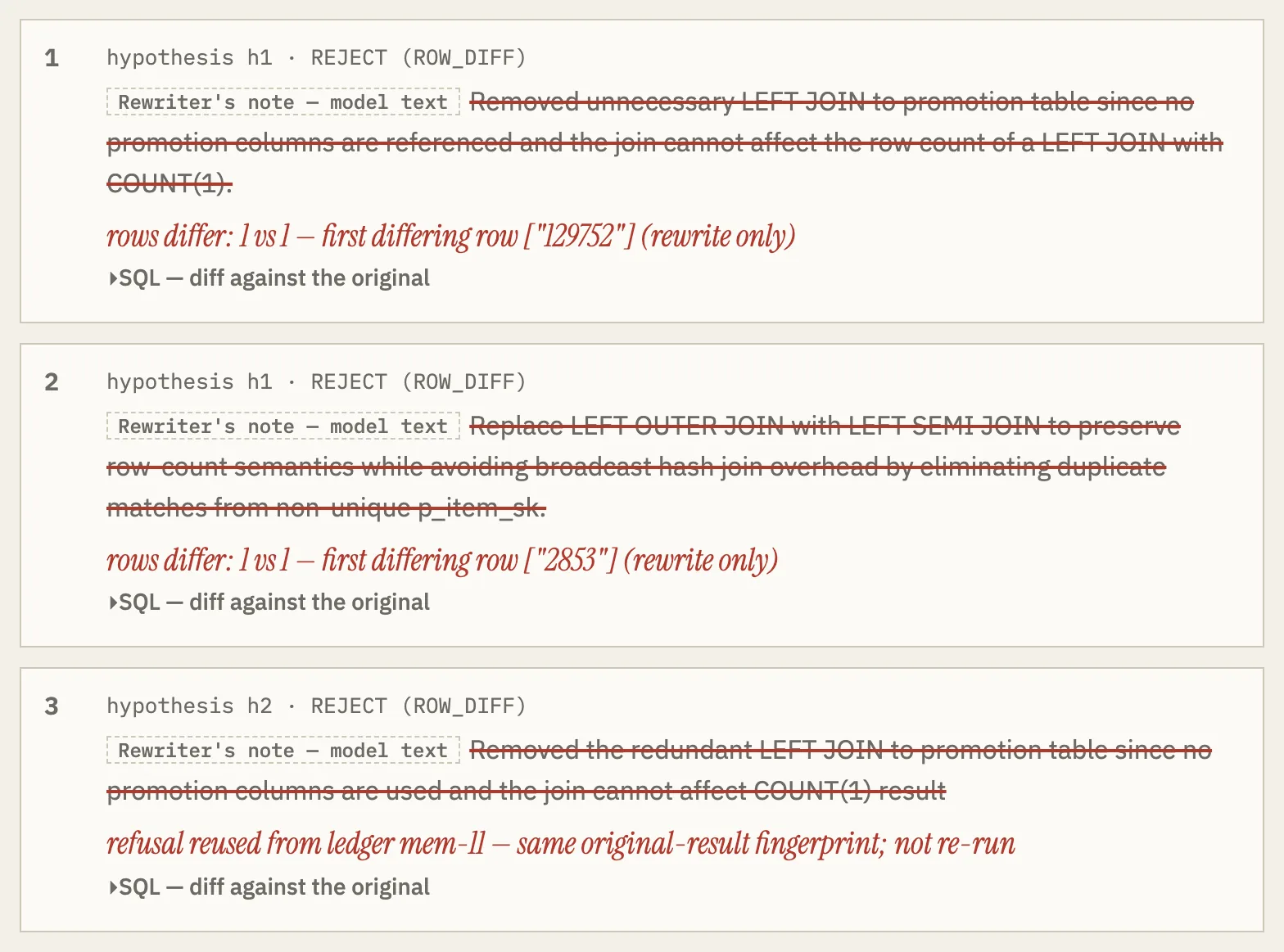
Same query, a different join key: p_item_sk, which repeats. Dropping the join now changes the count. The Rewriter tried three times; the Verifier refused two by execution and the third from its ledger, and wrote why in the margin.
hero-r1 · ON p_promo_sk
300 distinct
of 300 non-null values · fingerprints 87cd00c5 = 87cd00c5
attempt 3 · drop the join againrefused from the ledger
verdictNO_SAFE_REWRITE
Without the Verifier
Sample pack on DuckDB (the hero, three traps, a control): one plain model call per query, no diagnosis, no memory, one attempt — scored by the same Verifier.
■ changed rows 6□ identical, not faster 5⬚ guard / error 4identical and faster 0
With it
On the same trap queries the baseline changed rows in 3 of 9 runs, and Query Doctor's own first rewrite in 9 of 15. Every one of those 9 was refused.
▨ changed rows, refused 9□ other first attempts 6shipped with changed rows 0
scroll the screen sideways →
Real screen · #/recorded/hero-trap-r1 · Attempts
Designed queries, small N — the shares are not a rate on real workloads (evals/results.md).
Four sponsors, four jobs.
Zetaris
The engine both queries run on, over JDBC to the local platform: run_sql, EXPLAIN FORMATTED, engine-side xxhash64 fingerprints. The local bundle has no MCP endpoint, so no MCP tools are used.
11calls in hero-r1: 10 run_sql + 1 EXPLAIN
Meterless
H-MEM is the playbook, Markovian is the retry chain. Nightshift is the default model provider in code, tested against a mock runtime only.
Nemotron 3 Ultra serves the Diagnoser and the Rewriter. The recorded runs called it directly through NIM, the declared fallback.
2model calls in hero-r1: diagnose + rewrite
Cursor
Cursor's agent wrote the scaffold commit (d3e823c). Claude Code wrote the rest; every commit says which.
1commit, the scaffold
Honest by design · from the README
What it can't do yet.
COMMENT 1
“The retry loop does not reliably learn from a refusal: on the duplicated-key hero trap the first two attempts changed the rows when executed (one dropped the join, one swapped it for a LEFT SEMI JOIN) and the third repeated the first and was refused from the ledger without running, although the prompt carried the measured fact that the key is not unique.”
— README · Limitations
COMMENT 2
“Nightshift was never run live; there is no hosted CI run to cite (GitHub Actions did not start on the private repo).”
— README · Limitations
COMMENT 3
“We expected a 5–12 s hero; it runs about 35 s, so one live verification takes minutes, not seconds.”
— README · What we got wrong
Questions a judge would ask
Before you sign off.
Does a model decide whether a rewrite ships?
No. The Verifier is deterministic code: it executes both queries, compares the rows and times alternating pairs. The model's text is labelled as model text in every report and never decides anything.
Is the 2.11× measured or estimated?
Measured: wall clock on the local Zetaris platform over JDBC, 10 alternating pairs, rows verified identical first. The p50s are 32,442.6 ms and 16,428 ms. It is one laptop and says nothing about a hosted deployment.
Can I run it without keys?
Yes. Sample mode runs DuckDB on a committed NYC TLC subset with recorded model answers, and all 447 tests run keyless. The sample pack has no ACCEPT: the accepted speedup is from live Zetaris only.
What is not shown live?
Meterless Nightshift. It is the default provider in code with 16 mock-runtime tests, but it was never run against a live runtime; every recorded run used direct NVIDIA NIM, and every recorded trace with a model call names nim.
Will it change my database?
No. The guard admits one read-only statement per query; a rewrite cannot write or run a second statement. An accepted case is a candidate; when a human approves it, a patch file is written for them to review and apply.
Is "same rows" a proof?
No, and the report says so: the rewrite is identical on the current data and verified by execution — it is not a proof for all future data.